KAG-Meldewesen (FMA)¶
The KAG-Meldewesen extension supports reports of Austrian management companies (KAG, AIFM) to the Austrian Financial Market Authority (FMA):
- the AIFMD reporting (Annex IV of Regulation (EU) 231/2013, § 22 AIFMG): the AIFM file and the AIF file in ESMA's XML format;
- the money market fund report (Article 37 of Regulation (EU) 2017/1131, quarterly via the FMA to ESMA) in ESMA's ISO 20022 format;
- the derivative risk report of UCITS management companies (§ 2a of the 4. DeRiMV, quarterly) in the FMA's XML format.
| Report | Root element | Schema |
|---|---|---|
| AIFM file | AIFMReportingInfo |
ESMA AIFMD_DATMAN_V1.2.xsd |
| AIF file | AIFReportingInfo |
ESMA AIFMD_DATAIF_V1.2.xsd |
| Money market fund report | BizData (head.003) with Document (auth.093), or Document alone |
ESMA MMF schemas v04.1 |
| Derivative risk report | Derivatemeldung (no namespace) |
FMA Derivatemeldung.xsd + DerivateTypes.xsd (2016) |
The extension is off by default: switch it on in Settings → Extensions → INSTALLED EXTENSIONS
(plugin.kag-meldewesen.enabled) and restart.
What it does¶
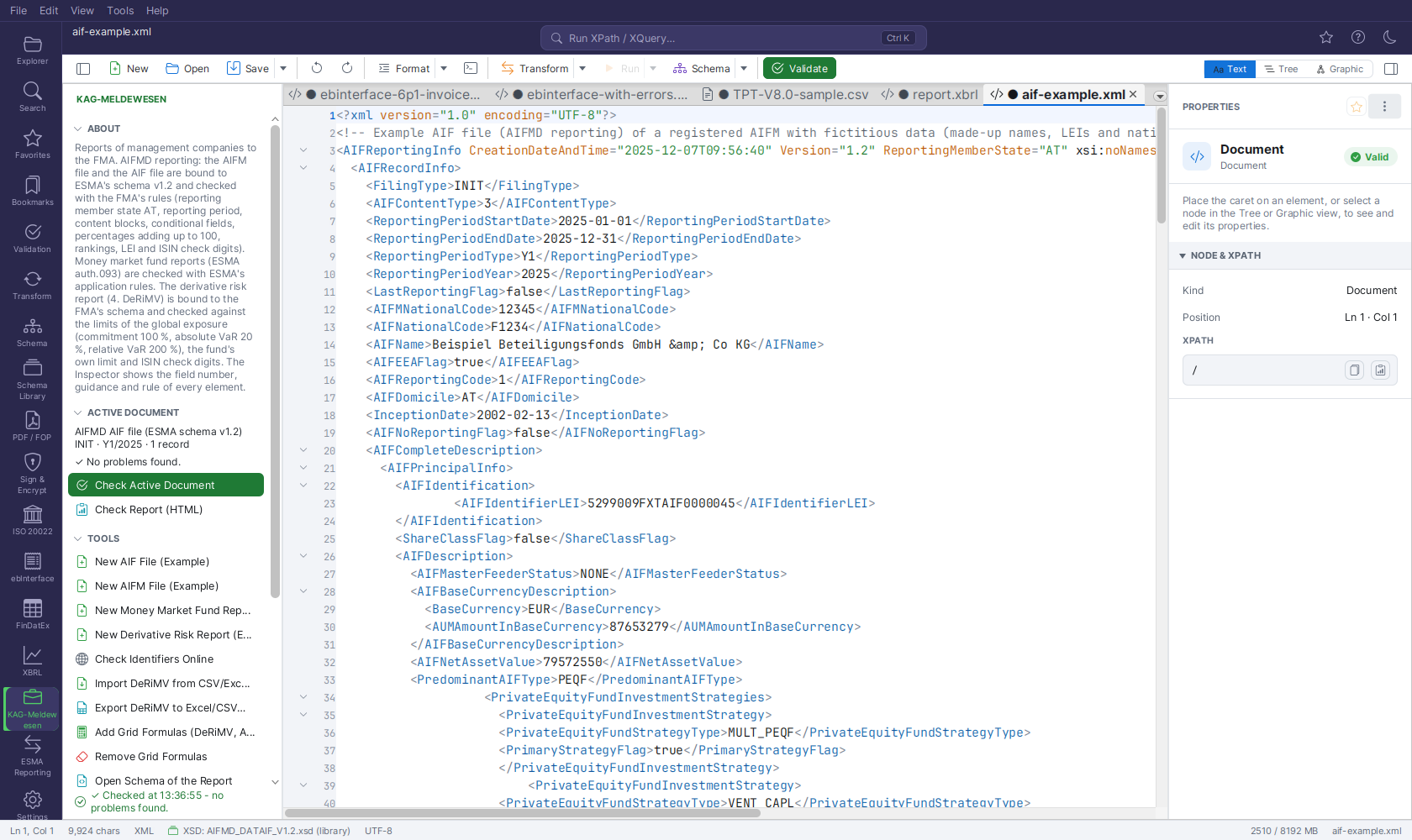
- Schema binding: both files are bound to ESMA's schemas v1.2 (shipped with the application) by their root element - validation (F8), IntelliSense, the grid and the Inspector use them.
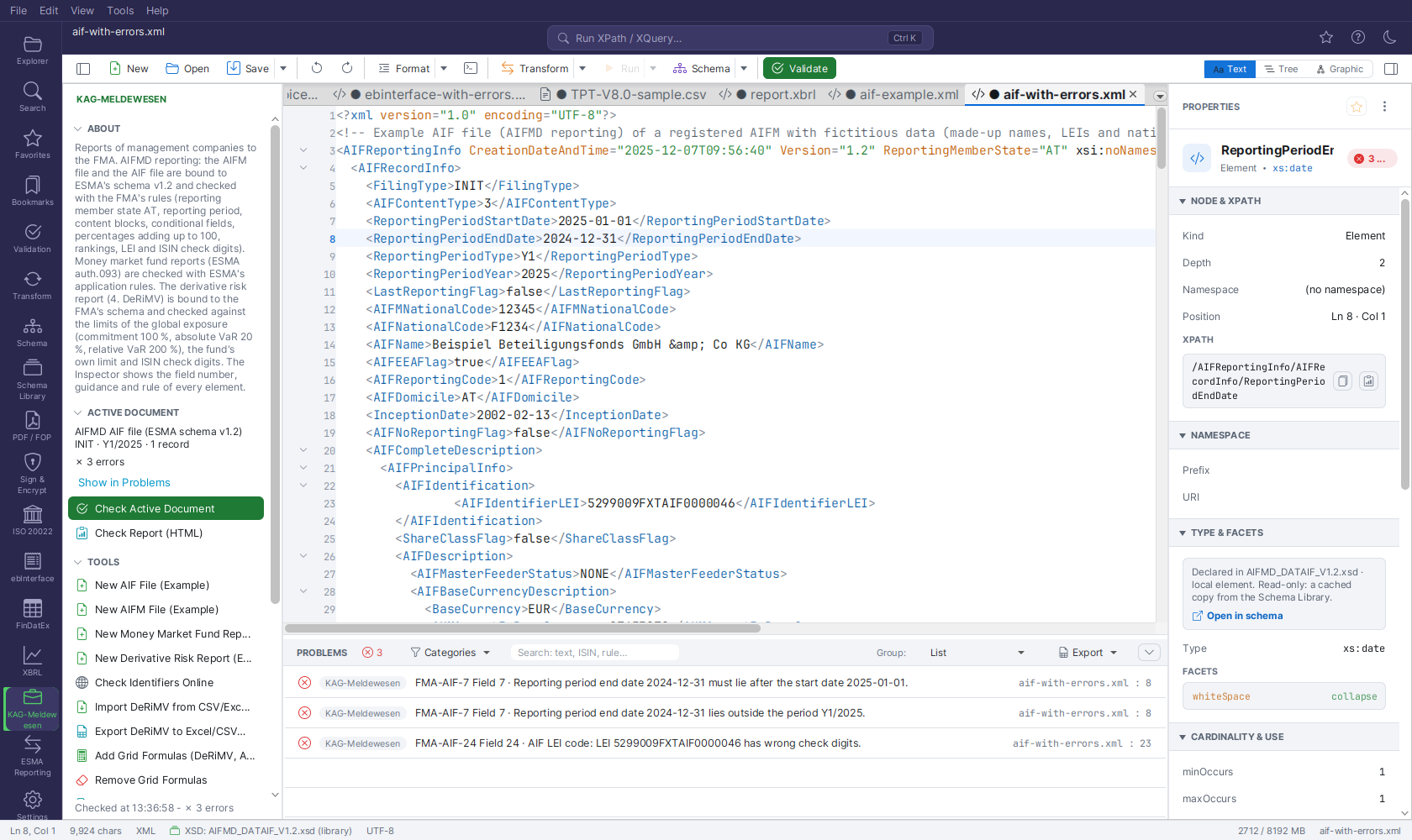
- FMA rules: the FMA's Prüfregeln AIF / AIFM Reporting File (as of 29.01.2024) run with every
validation (F8, Validation panel,
fxt-cli validate). Each finding names the rule (FMA-AIF-<field>,FMA-AIFM-<field>after the field number of ESMA's tables) and the field, and jumps to its line:- reporting member state
AT, reporting period (start date matches the period type, end date after the start and inside the period), change quarter of a reporting obligation change; - the blocks an AIF content type requires (principal information, individual information,
leverage under Article 24(2) and 24(4)), nothing below
AIFCompleteDescriptionwhen the no-reporting flag is set; - conditional fields: share class, master-feeder, base currency and FX rate, instrument
identification (ISIN, AII), asset types
NTA, market code typesMIC/OTC/NOT, private equity only fields, risk measure types (NET_DV01,NET_CS01,VEGA_EXPO,VAR…), counterparty and CCP exposures, redemption rights, borrowing sources; - percentages that add up to 100 % (strategies, geographical focus of NAV and AuM, investor concentration, trading and clearing mechanisms, portfolio liquidity, investor groups, financing liquidity), with 0.5 percentage points for rounding;
- rankings: the values of a ranked list do not grow with the ranking;
- NAV not above the AuM, main instruments not above the AuM (1 % tolerance), inception date before the reporting period, monthly values only for months of the reporting period;
- individual exposures: every sub-asset type of the main instruments appears among them
(
FMA-AIF-121), long and short currency exposures add up to the AuM within 1 % (FMA-AIF-129), transaction type and voting rights required for private equity (FMA-AIF-134,FMA-AIF-136); - LEI and ISIN check digits.
- reporting member state
The checks of the national codes against the lists of the Incoming Platform can only run there.
- Field labels: select an element (text, tree or grid) and the Inspector's DOCUMENTATION starts
with its ESMA field number and name, the M/C/O/F obligation, the FMA's rule and ESMA's technical
guidance; the grid shows the same as tooltip of the element's name.
- Status bar badge: AIFMD AIF Y1/2025, AIFMD AIFM Q4/2025, MMF Q1–Q4/2026, DeRiMV Q4/2025; a click
opens the side panel.
- KAG-Meldewesen activity: what the active document is and how many errors and warnings its last
check found, Check Active Document (like F8: the problems go to the PROBLEMS panel below the editor
with a click to the line), Check Report (HTML), the TOOLS below, OPTIONS and an identifier checker (LEI,
ISIN, BIC).
- Tools: examples with fictitious data (New AIF File, New AIFM File, New Money Market Fund
Report, New Derivative Risk Report), Import DeRiMV from CSV/Excel…, Export DeRiMV to Excel/CSV…,
Add / Remove Grid Formulas, Open Schema of the Report and Schema Documentation (HTML).
- Templates, queries, favorites: opening the panel adds the four reports as templates (File → New,
category KAG-Meldewesen), analysis queries for the Query Console (tag kag-meldewesen: DeRiMV funds by use
of the limit or per method, AIF records, main instruments, geographical sums, MMF fund reports) and the
installed schemas as favorites.
- Field labels in the text: rest the mouse on a tag name and a popup shows the field number, name and rule.
- Help menu: FMA AIFMD Reporting opens the FMA's page with the rules and samples.
Submit the files on the FMA Incoming Platform. The schemas are installed under
~/.freeXmlToolkit/kag-meldewesen/aifmd-1.2/.
Money market fund report¶
The report is bound to ESMA's schemas v04.1 - the envelope (BizData, head.003), the business
application header (head.001) and the report (auth.093) together - and checked with the application
rules of ESMA's MMF validation rules v07 that need only the file (ESMA-MMF-<field code>):
- header: sender
AT(the FMA), recipientEU, message definitionauth.093.001.01, creation date after the reporting end date; - reporting year from 2020, period ranges (from/to quarter), start and end date inside the quarters, the authorising country equal to the sender, no two reports of one MMF and period in a file;
- share classes (one flagged with the highest NAV), inception, merger and liquidation dates;
- daily and weekly maturing assets below 100 %, the liquidity profile (four ranges, each once, adding up to 100 %), the yield breakdowns (each range type once), the input factor of the macro-economic stress scenarios;
- assets: counterparty name without LEI, no accrued interest for the valuation methods
MTMOandAMCS, reset dates after the reporting end date, amounts in the base currency next to the EUR amounts; - ISO 4217 currencies, ISO 3166 and EU countries, ISIN and LEI check digits.
The content rules of the same table:
| Area | Checks |
|---|---|
| Fund data | no overlapping reporting periods of one MMF in a year (6); LEI of the MMF and its manager required unless the data set action is NOTX (16, 24); a warning when the MMF's LEI is reused for a sponsor, counterparty or fund held; manager codes and authorising countries (26, 27); depositary LEI (37); master LEI and name iff the fund is a feeder (41–45); last report sent vs. liquidation or merger date (56, warning); funds above EUR 100 million report one quarter at a time (59, warning) |
| Yields, stress tests | cumulative returns: six range types, each once, and a warning for a range the inception date allows but which has no rate (68); rate vs. "not available" by MMF type (72–76, warnings); stress test dates: older than 6 months or a year, not 30/06 or 31/12, not all the same (80, warnings); scenario codes, LST-01 required for CNAV and LVNAV funds (83) |
| Assets | CFI code fits the asset type (ESMA's table of CFI constructs; 93, 121, 148, 178, 211); a warning for an asset without LEI (96, 124, 152, 181, 198, 214); credit assessment UFVB / NOVF, and NOAP outside money market instruments of EU public issuers (118, 145, 230, warnings); amortised cost in a VNAV fund (117, 144, warning); accrued interest required for MTMA (110); reverse repo collateral iff an RVPO asset exists (231) |
| Liabilities | investor concentration, investor groups and countries add up to 99.99–100.01 % (238–255); notice period 0 days in a UCITS (257, warning); four arrangement types, each once with a rate, OTHR described (258–260); monthly figures for every month of every quarter in the period and none outside (261–328); quoted currency = base currency, rate 1 for EUR (311–327) |
| LVNAV data | only for LVNAV funds, dates not after the reporting end, CFI code among the portfolio's (warning), price and NAV differences (warnings), basis-point thresholds of the deviations, measure date inside the period and after the event date (329–352) |
Of the table's 254 rule items, 211 run in the application; the other 43 need data only ESMA has: GLEIF, ESMA's register of authorised MMFs and earlier reports of the same MMF. Whether the reported LEIs are registered and still valid, and whether the ISINs exist and are still traded, can be checked online from the panel (Check Identifiers Online, see Online Identifier Lookup); for MMF reports this also compares every reported CFI code and issuer LEI with ESMA FIRDS - the check ESMA's rule 93 ff. makes against its reference database. New Money Market Fund Report (Example) opens a fictitious report.
Check report¶
Check Report (HTML) opens a page in the preview: counts of errors and warnings, every finding grouped by
rule with the field it belongs to (FMA-AIF-48 → Field 48 · …) and its line. For a DeRiMV report it adds
a table of every fund: exposure, maximum, the legal limit of its method and how much of it the fund uses,
the fund's own limit (absolute VaR) and its use, the most used first; funds above a limit are red, those at
90 % or more (or the threshold of the options) amber.
Options¶
| Option | Default | Effect |
|---|---|---|
| AIFMD: tolerance of sums of percentages | 0.5 percentage points | how far a list that must add up to 100 % may be off |
| DeRiMV: relative VaR warning above | 200 % | the relative VaR limit of rule DeRiMV-7 |
| DeRiMV: warn from this use of a limit | off, 90 % | rule DeRiMV-use: a warning for a fund within its limit but at this share of it or more |
Settings kag.aifmd.sumTolerance, kag.derimv.relativeVarLimit, kag.derimv.utilisationWarning,
kag.derimv.utilisationWarningAt; a change counts from the next check.
Grid formulas¶
Add Grid Formulas opens a copy of a DeRiMV report or an AIF file in the Graphic view with grid formulas and a saved filter, inserted into the text so the rest of the file stays as it was:
- DeRiMV, on
Derivatemeldung: funds, funds per method, highest use of a legal limit, funds at the warning threshold or above, funds above a limit, highest absolute VaR; the filter shows the funds at the threshold or above (switched off until you click it); - AIF file: the sum of every percentage list that must add up to 100 (geographical focus of NAV and AuM, strategies, investor concentration, trading and clearing, portfolio liquidity, investor groups, financing).
Remove Grid Formulas opens a copy without them - submit that one.
Derivative risk report (4. DeRiMV)¶
The whole report of a management company is one XML file (§ 2a Abs. 1): the company's name, bank code
(BLZ), year and quarter as attributes of Derivatemeldung, then one InvestmentFonds per UCITS with the
items of § 2a Abs. 2 (as amended by BGBl. II Nr. 242/2016): FMA code, ISIN, fund name, global exposure at
the reporting date and the maximum of the period in percent, the method (Comm, aVaR, rVaR) and,
optionally, the fund's own limit. It is bound to the FMA's schema of 2016 (installed under
~/.freeXmlToolkit/kag-meldewesen/derimv-2016/) and checked with these rules (DeRiMV-<item>):
| Rule | Check | Severity |
|---|---|---|
DeRiMV-4 |
ISIN check digit; every ISIN once in the file | error |
DeRiMV-7 |
exposure at the reporting date not above the period maximum | error |
DeRiMV-7 |
commitment approach at most 100 % of the net asset value, absolute VaR at most 20 % | error |
DeRiMV-7 |
relative VaR at most 200 % (twice the reference portfolio's VaR) | warning |
DeRiMV-9 |
absolute VaR: period maximum not above the fund's own limit, own limit not above 20 % | warning |
DeRiMV-period |
the quarter has ended; reports from the reporting date 31 December 2016 | warning |
The FMA publishes no rule catalogue for this report, so the rules follow the regulation. The report carries no confidence level, holding period, reference portfolio or net asset value - these VaR parameters cannot be checked on the file. The relative VaR check is only a warning: reports give the ratio to the reference portfolio (limit 200 %), while the formula of § 16 Abs. 1 Z 3 since 2016 measures the excess over it (limit 100 %), and the regulation does not say which of the two the field holds. The FMA codes per fund are provided on the Incoming Platform. New Derivative Risk Report (Example) opens a fictitious report.
From and to a spreadsheet¶
Risk management often keeps the report as CSV or Excel in the FMA's former CSV layout: row 1 holds the
management company, the bank code and the period as JJJJQ (20254 = Q4/2025), then one row per fund with
the columns A–G FMA code, ISIN, fund name, exposure, maximum of the period, method and own limit (CSV with
semicolons and a decimal comma). Import DeRiMV from CSV/Excel… turns such a file into the XML report,
opens it and checks it: the encoding (UTF-8 or Windows-1252) and the decimal separator are detected, the
method is normalised (avar → aVaR), values get two decimals, a bank code is padded to five digits and a
fund name cut to 100 characters. Rows that need a look (no ISIN, a value that is no number, an unknown method)
are listed in the side panel; they are imported as they are, so the check shows them in the report.
Export DeRiMV to Excel/CSV… writes the active report as an Excel workbook in the application's style (sheet
Funds with one row per fund, sheet Info with the header) or - for a .csv name - in the CSV layout; both
can be imported again.
Sources¶
ESMA: AIFMD reporting XML documents v1.2 (2013-1361) and IT technical guidance rev 6 (2013-1358).
FMA: Informationen zum Inhalt und zur Übermittlung des AIFMD-Reportings (December 2023) and the
Prüfregeln (29.01.2024). ESMA: MMF reporting XML schemas v04.1 and validation rules v07
(esma65-8-6480). The field catalogues are generated with scripts/aifmd-fields.py and
scripts/esma-mmf-fields.py. 4. DeRiMV (BGBl. II Nr. 266/2011 as amended by BGBl. II Nr. 242/2016) and
the FMA's XSD of 6 October 2016; its field labels (derimv/derimv-fields.json) are written by hand.