ESMA Reporting (EMIR, SFTR, MiFIR)
The ESMA Reporting extension supports ESMA's transaction reports in ISO 20022 - starting with
the EMIR Refit derivatives trade report (auth.030.001.03, ESMA usage guideline DATTAR 1.1.0)
and the SFTR securities financing transaction report (auth.052.001.02, usage guideline 1.2.0),
which counterparties (also management companies for their funds) send to a trade repository, and the
MiFIR transaction report (auth.016.001.01), which investment firms send to their supervisor.
The extension is off by default: switch it on in Settings → Extensions → INSTALLED EXTENSIONS
(plugin.esma-reporting.enabled) and restart.
What it does
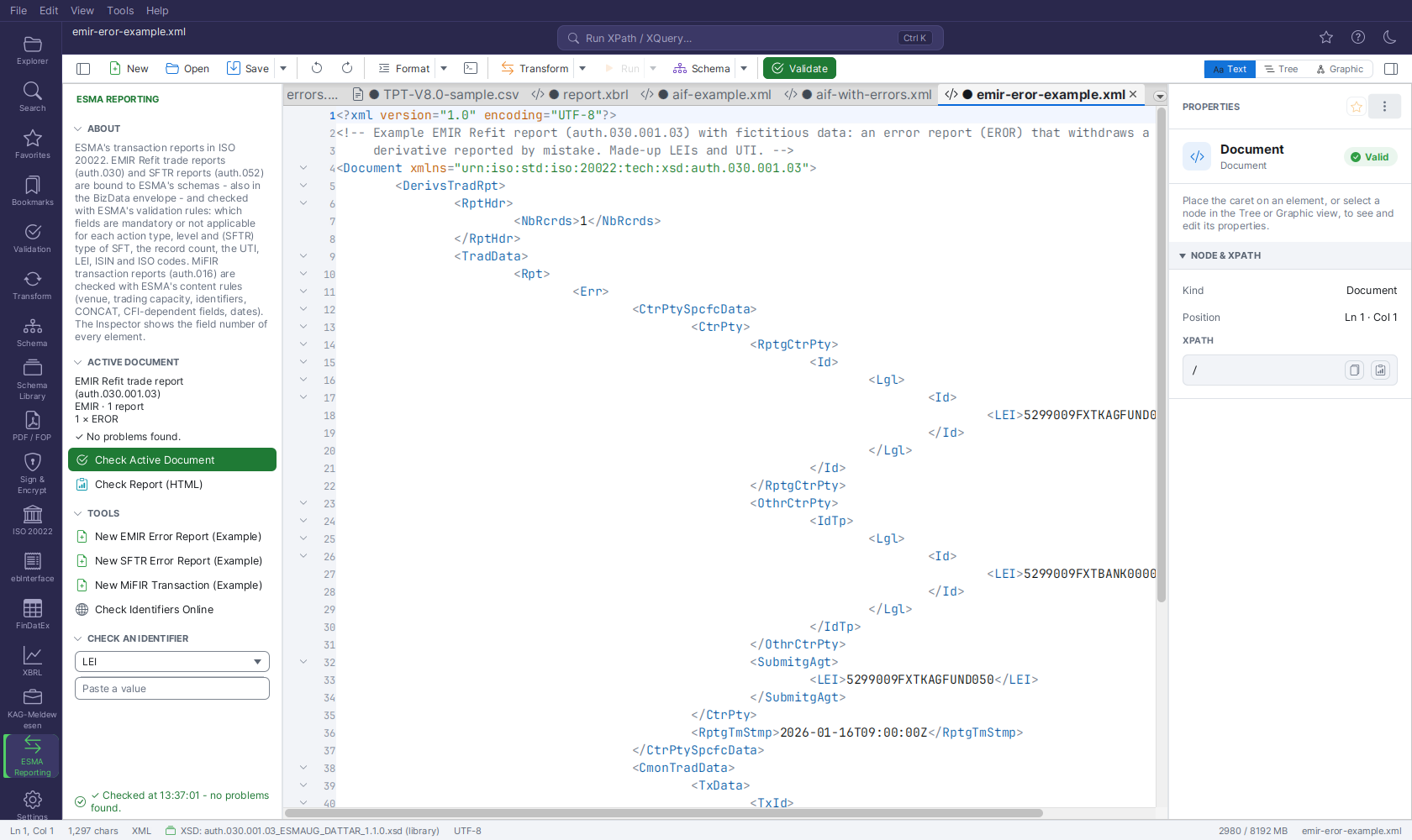
- Schema binding: a report that starts with
Documentin theauth.030.001.03namespace is bound to ESMA's schema; a report in the business data envelope (BizData, head.003, with the business application header head.001) is bound to a driver schema that validates envelope, header and report together. The same driver is used for ESMA's money market fund report of the KAG-Meldewesen extension. -
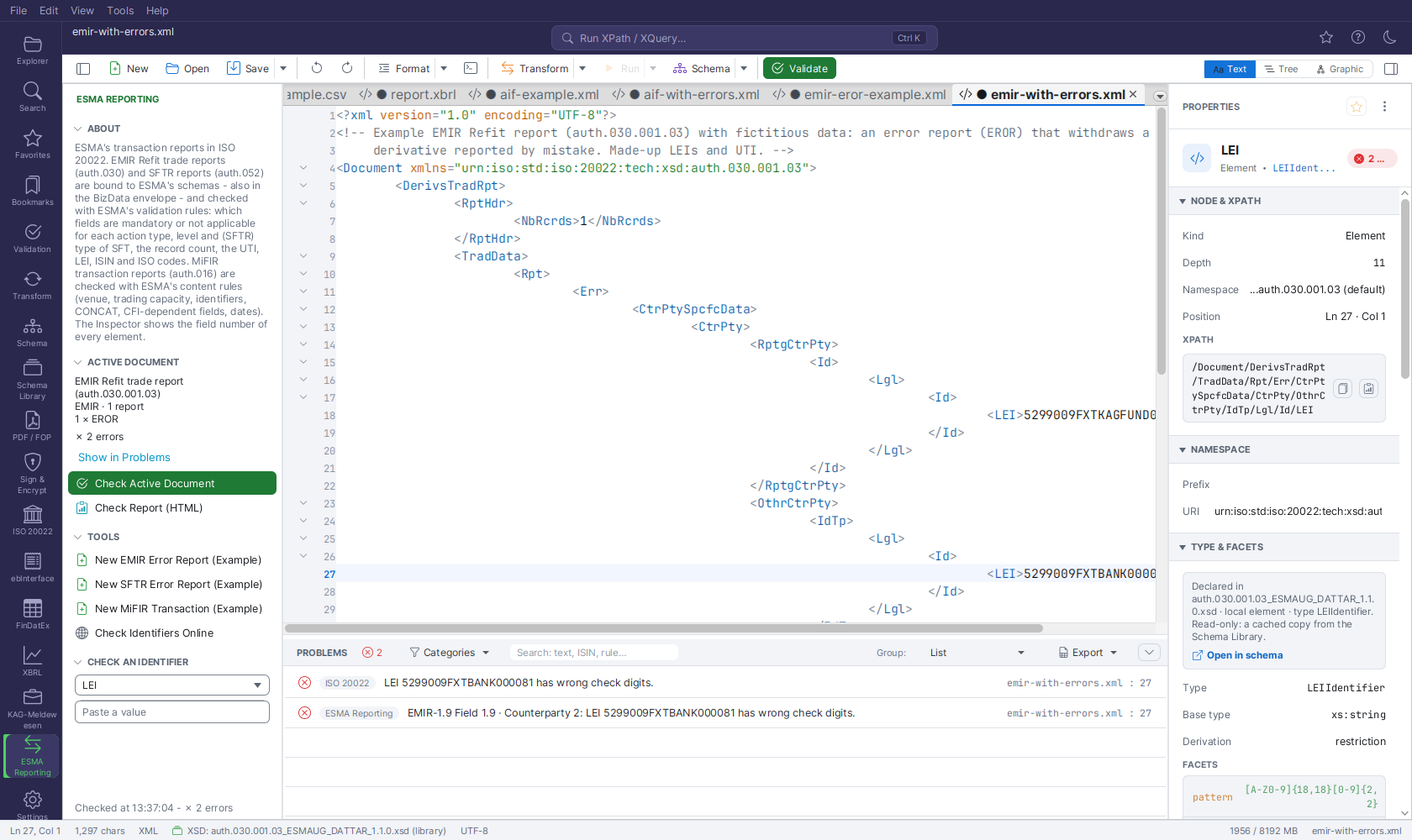
ESMA's validation rules: with every validation (F8, Validation panel,
fxt-cli validate):- per action type and level - for each report (
New= NEWT,Mod= MODI,ValtnUpd= VALU,Crrctn= CORR,Termntn= TERM,Err= EROR,Rvv= REVI,PosCmpnt= POSC; level fromLvl, trade or position) the fields ESMA marks mandatory must be reported and those marked not applicable must not:EMIR-1.1 Field 1.1 · Reporting timestamp is mandatory for action type VALU. The table comes from ESMA's EMIR Refit validation rules (esma74-362-2683); - the number of records in the header against the reports;
- the UTI (an LEI followed by up to 32 letters or digits);
-
LEI and ISIN check digits, ISO 3166 country codes.
-
conditional fields (C in ESMA's table): whether they must or must not be reported depends on other fields, and ESMA's rules say how -
EMIR-1.7 Field 1.7 · Clearing threshold of counterparty 1 must be reported when 1.5 Nature of the counterparty 1 is N,EMIR-2.33 Field 2.33 · Central counterparty must not be reported when 2.31 Cleared is N. Codes the schema expresses by a choice of elements are read as ESMA's codes (NFI= N,Clrd= Y). Values within a schedule period or another payment are compared with that period or payment only; also "at least one of" and "only one of" groups (2.13 / 2.79 / 2.85 for interest rates) and codes that must differ (report tracking number, prior and subsequent UTI). -
dates and timestamps in the order ESMA requires: execution before valuation, confirmation and clearing, these not after the reporting timestamp nor after the expiration (or early termination) date, expiration and settlement not before the execution, the valuation on the event date, no dates before 2014-02-12 (
EMIR-2.23 Field 2.23 · Valuation timestamp … must not be
  later than field 1.1 · Reporting timestamp (…)
). Where ESMA says "should" (event date on the day of execution for NEWT and POSC, on the reporting day for REVI and EROR) it is a warning. Two timestamps are compared to the second, a date with a timestamp by the day.
- per action type and level - for each report (
Not checked are the conditions that need reference data - the kind of venue behind a MIC (regulated
market, systematic internaliser), GLEIF, the UPI database, the EIC code lists - the time the trade
repository receives the report, and comparisons with earlier reports of the same UTI. ESMA's full
rules text is in the Inspector.
- Field labels: every element shows its EMIR field number and name, the obligation per action
type, ESMA's rules text and the details to be reported in the Inspector's DOCUMENTATION and as grid
tooltip - also inside the envelope.
- Status bar badge: EMIR · 3 reports, SFTR · 1 report, MiFIR · 2 transactions; the side panel lists the reports per action type.
- ESMA Reporting activity: the document's summary with the counts of its last check, Check Active
Document (like F8: the problems go to the PROBLEMS panel with a click to the line), Check Report
(HTML) (the findings grouped by rule with their EMIR/SFTR/MiFIR field), an LEI/ISIN checker and examples
with fictitious data.
- Field labels in the text: rest the mouse on a tag name and a popup shows the field number, name and rule.
SFTR
SFTR reports (Document in the auth.052.001.02 namespace or in the BizData envelope) are checked
the same way, with ESMA's SFTR validation rules (ESMA74-362-1008): the table distinguishes the
action type (New = NEWT, Mod = MODI, Err = EROR, EarlyTermntn = ETRM, PosCmpnt = POSC,
CollUpd = COLU, Crrctn = CORR, ValtnUpd = VALU), the level (LvlTp: TCTN or PSTN) and the type
of SFT, read from the loan data (RpTrad repo, BuySellBck buy-sell back, SctiesLndg securities
lending, MrgnLndg margin lending) - SFTR-2.3 Field 2.3 · Event date is mandatory for action type
COLU. The conditional fields are checked as for EMIR, the collateral fields per collateral component
(SFTR-2.78 Field 2.78 · Identification of a security used as collateral must be reported when 2.75 Type of
collateral component is SECU); ESMA's "should" rules (lending fee, collateral or basket identifier) are
warnings. Dates too: the event date not after the reporting timestamp, not before the execution and not after
the maturity (or termination) date, value date not before the execution, maturity not before the value date,
termination date between execution and reporting. UTI, LEI and ISIN are checked too; New SFTR Error Report (Example) opens a fictitious report.
MiFIR
MiFIR transaction reports (Document in the auth.016.001.01 namespace or in the envelope) are
checked with the content rules of ESMA's MiFIR transaction reporting validation rules
(esma65-8-2594) that need no instrument reference data, GLEIF or MIC register; the rule id is ESMA's
error code:
- venue: no trading venue transaction code, branch country or waiver indicator for
XOFF/XXXX(CON-030, CON-372, CON-610); a transmitted order is reported withXOFF/XXXX(CON-362); - trading capacity: no transmission for
DEAL/MTCH(CON-251); withDEALthe buyer or seller is the executing entity (CON-290) and the investment decision within the firm is reported (CON-570); - LEIs of executing, submitting and transmitting firms, buyers, sellers and decision makers; ISINs of instrument and underlyings; branch countries; national identifiers start with a country code; CONCAT codes (20 characters, date of birth as in the person's data); dates of birth not after the trading date;
- currencies: ISO 4217 without the special codes (XAU, XXX …);
- the instrument fields the CFI code (field 43) makes mandatory or forbids: notional currencies, underlying index name and term, option type (and its value for calls, puts, others), strike price, exercise style, maturity and expiry date (CON-441 … CON-551); maturity and expiry not before the trading date.
New MiFIR Transaction (Example) opens a fictitious share purchase on a venue.
Sources
ESMA: EMIR Refit incoming messages 1.1.0 (usage guidelines and schemas) and EMIR Refit validation
rules (esma74-362-2683); SFTR counterparty and TR data exchange 2023 and SFTR validation rules
(ESMA74-362-1008); MiFIR transaction reporting XML schema 1.1.0 (ESMA65-8-2598) and validation rules
(esma65-8-2594). The field catalogues and the action-type tables are generated with
scripts/esma-emir-fields.py, scripts/esma-sftr-fields.py and scripts/esma-mifir-fields.py (the
MiFIR element-to-field mapping of RTS 22 is part of that script).